
Software 3.0 Redefines Programming as LLMs Turn Language Into the Interface
As prompts, context, and tool use become the new building blocks of computing, software is shifting from hard-coded instructions to systems that can interpret, adapt, and act.

There is a reason Andrej Karpathy’s idea of “Software 3.0” keeps spreading. It gives people a simple way to name a change that already feels obvious in practice: we are moving from telling computers exactly what to do, to training systems on what good behavior looks like, to increasingly steering general-purpose models with language, context, and tools.
In Karpathy’s YC keynote introducing “Software 3.0”, natural language becomes the programming interface. In his earlier “Software 2.0” essay, he had already framed neural networks as software written through datasets, objectives, and architectures rather than explicit line-by-line rules.
The simplest way to understand the shift
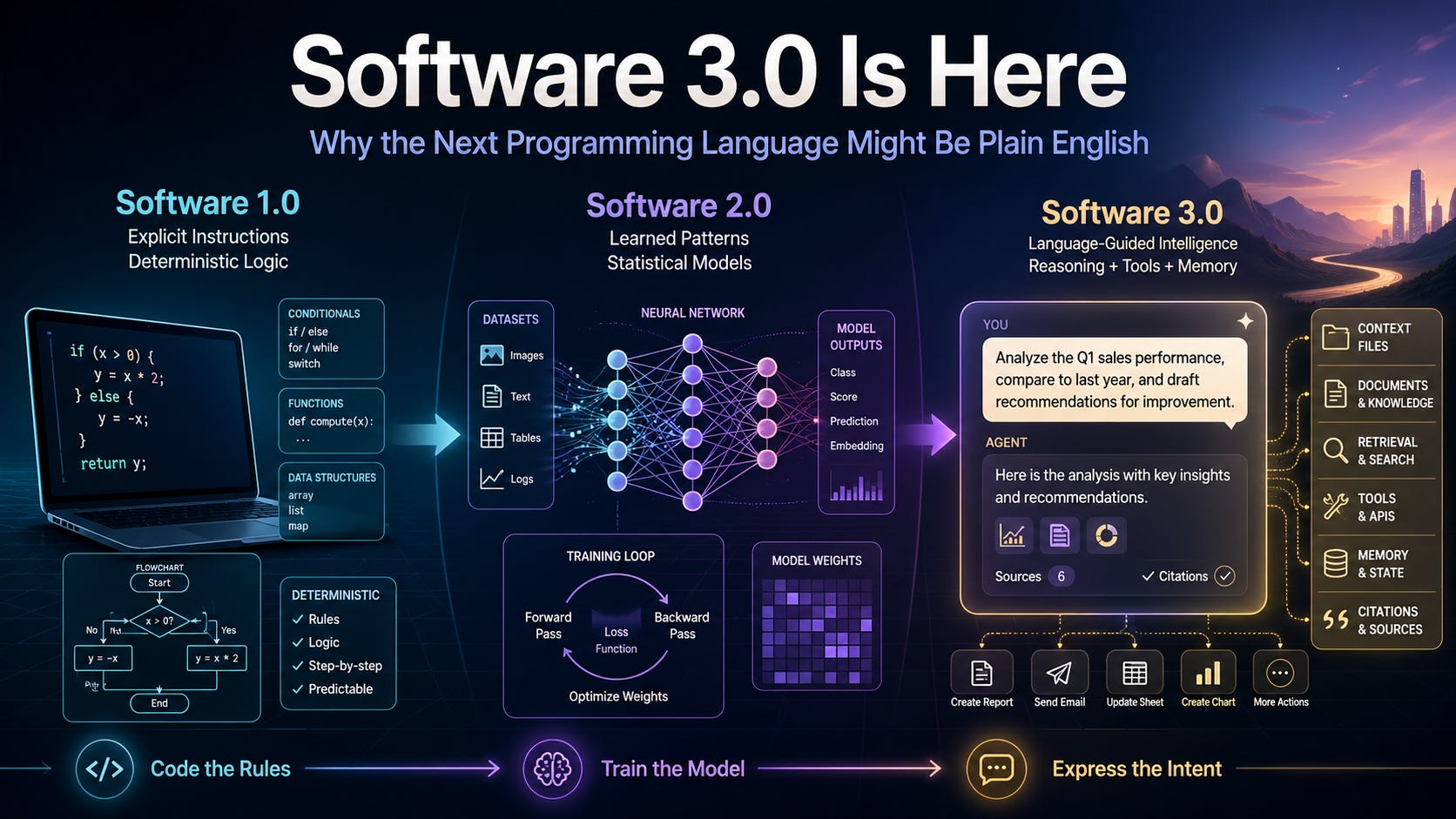
Think of the last three eras like this:
Software 1.0
You write explicit instructions. Bash scripts, Python files, backend services, conditionals, loops. The programmer picks the path.
Software 2.0
You define behavior through data and optimization. As Karpathy put it in “Software 2.0”, the “source code” becomes the dataset plus the neural net architecture, and training compiles that into model weights. The programmer shapes the search space.
Software 3.0
You increasingly “program” a model with prompts, examples, tools, and context. That is not just prompting in the narrow sense. It is also what Anthropic now calls context engineering for agents: deciding what instructions, files, tools, history, and retrieved knowledge the model gets to work with. Google’s long-context docs for Gemini describe the context window as a kind of short-term memory, which is a useful mental model for why context now matters so much.
The real breakthrough is not “AI writes code faster”
That is true, but it is too small a description.
The deeper change is that general information processing is becoming programmable. You are no longer limited to automating well-structured tasks with rigid pipelines. Modern agent stacks can ingest messy documents, search across multiple sources, rerank evidence, and produce grounded responses with citations. Microsoft’s Copilot Studio knowledge sources guide and Azure AI Search documentation on agentic retrieval both describe systems where agents use knowledge sources, parallel retrieval, and grounded answers to work across unstructured enterprise content.
That matters because a huge amount of real work has always lived in a gray zone: PDFs, screenshots, emails, policy docs, support transcripts, product specs, onboarding notes, meeting recordings, vendor instructions, compliance files. Software 1.0 was often too brittle for that terrain. Software 2.0 helped classify and predict. Software 3.0 starts to operate on the mess itself.
Two examples that make the shift feel concrete
1) The OpenClaw lesson: the shell does not disappear, it gets delegated
The official OpenClaw install docs still show a one-line installer script, and the getting started guide says you can install, run onboarding, and chat with your assistant in about five minutes. Its tools documentation explains that tools are how the agent reads files, runs commands, browses the web, sends messages, and interacts with devices. Its security page is blunt: your assistant can execute arbitrary shell commands, read and write files, and access network services.
So the important idea is not that Software 3.0 magically deletes Software 1.0. It is that the old command surface can become an execution substrate for an agent. Karpathy made a related point in his MenuGen write-up: services should become more LLM-friendly because users will increasingly copy-paste instructions into models, so docs, CLIs, curl commands, and Markdown become better interfaces than click-heavy flows. That is a profound product design clue.
Practical takeaway
If your product can only be driven comfortably by a human clicking through a maze of forms, it may be badly positioned for Software 3.0. If it exposes clean text instructions, APIs, CLIs, machine-readable docs, and predictable tool behavior, it is far more likely to thrive.
2) The MenuGen lesson: some “apps” collapse into a prompt-shaped workflow
Karpathy’s MenuGen prototype turns menus into food imagery, and in his post about building it he argues that the app might not need to be a full-featured app at all, because much of it is simply OCR plus image generation wrapped in a neat experience. Pair that with Google’s Nano Banana 2 image generation and editing capabilities and the implication is hard to miss: as multimodal models get better at reading images, understanding layout, following instructions, and rendering edits, a category of thin applications starts to look less like durable software and more like temporary packaging around a capability.
That does not mean every app disappears. It means many apps will be forced to answer an uncomfortable question:
Are we a real product, or are we just a clever wrapper around a workflow a model can now do directly?
That question is going to get sharper, not softer.
What becomes valuable in a Software 3.0 world
Here is where the opportunity gets interesting.
1. Context becomes product
Not just prompts. Context. The right files, the right memory, the right retrieval, the right permissions, the right history, the right tool access. Anthropic’s context engineering article makes this point clearly, and Microsoft’s Foundry IQ documentation shows how knowledge bases, multi-source retrieval, and permissions become part of the application layer.
2. Interfaces become more conversational, but infrastructure matters more
Users may see a chat box. Underneath, the winners will be the teams that can orchestrate retrieval, citations, access control, tool calls, and fallback behavior. Microsoft’s Azure AI Search overview describes this as a knowledge base plus multi-source retrieval plus LLM-assisted planning, which is a good description of where product complexity is moving.
3. The moat shifts from UI polish to trusted execution
In Software 1.0, a lot of value lived in carefully engineered flows. In Software 3.0, more value may live in safety, reliability, observability, permissioning, memory quality, and domain grounding. When an agent can run commands or touch your documents, the differentiator is not just what it can do, but whether you trust it to do it correctly. OpenClaw’s own security warning is a useful reminder that power and risk now travel together.
A few myths worth clearing up
Myth: Software 3.0 replaces Software 1.0 and 2.0.
It does not. Deterministic code, infrastructure, and trained models still matter. Software 3.0 sits on top of them and coordinates them.
Myth: Better prompting is the whole game.
It is not. As Anthropic’s context engineering note argues, capable agents depend on curating the whole evolving context state, not just crafting one clever instruction.
Myth: Bigger context windows solve everything.
They help, a lot. But Google’s Gemini long-context guide still frames the context window as limited short-term memory, and Anthropic warns that too much context can lead to confusion or “context rot.” More room is useful, but good selection still matters.
What builders should do now
A practical checklist
Design for machine readability
Prefer Markdown docs, clean APIs, CLI access, and structured outputs.
Assume an agent may become one of your primary users.
Invest in context and prompt engineering
Decide what should live in the prompt, what should be retrieved, what should be remembered, and what should be gated.
Treat prompts like specs, not wishes
OpenAI’s prompt engineering guide is a reminder that prompts are already operational artifacts. They need structure, clarity, and iteration.
Build for grounded answers
Knowledge bases, source retrieval, and citations are not optional extras for serious use cases. They are how Software 3.0 becomes trustworthy.
Put hard guardrails around action-taking
If an agent can run commands, message people, or access sensitive files, safety architecture is part of the product, not a feature request for later.
The big idea
Code executes rules. Models learn patterns. Agents handle ambiguity.
Software 3.0 is not just “coding with AI.” It is a shift in what we mean by programming.
In Software 1.0, we wrote the steps.
In Software 2.0, we shaped the training process.
In Software 3.0, we increasingly specify intent, context, and constraints, then let a model interpret and act.
The Software 3.0 Stack
Software 1.0 = Execution
Software 2.0 = Recognition
Software 3.0 = Orchestration
That makes the relationship very clear:
Code does
Models detect
Agents decide and coordinate
That changes not only how software is built, but what kinds of products make sense to build at all. Some apps will get thinner. Some workflows will disappear into model-native interfaces. And entirely new categories, especially around messy knowledge work, will finally become practical.
So here is the question worth arguing about in the comments: if the best software increasingly looks like well-curated context plus trusted execution, which products are actually defensible, and which ones are just waiting to be turned into a prompt?
Interesting that you say training Computers or a good behaviour looks like no I don’t agree training Computers what behaviour looks like good and bad🙄🤮😠😡🤬🤥🤣😂